



If you’re a freelancer, the usual advice of three months’ emergency savings is dangerous.
You should aim for six to twelve months of real living costs because there’s no steady paycheck or unemployment safety net.
Keep that cash where you can access it the same day, like a high-yield savings or money market account that is FDIC or NCUA insured (bank protection up to $250,000).
Start with one month, then automate a percentage of every payment until you hit your target; this post shows how to calculate the amount and pick the right account.
Determining the Right Emergency Fund Size for Freelancers
Freelancers need six to twelve months of living expenses saved, not the three to six months you’ll hear thrown around for traditional employees. There’s a reason for that gap. No employer. No steady paycheck. And in most places, zero access to unemployment when clients disappear.
Start by listing every recurring expense you pay each month. Pull up your bank and credit card statements from the last three months to see what you actually spend, not what you think you spend. Multiply that monthly total by six. Then by twelve. That’s your range. If you’re consistently burning through $4,000 a month, you’re looking at $24,000 to $48,000 sitting in savings. The spread depends on how wild your work gets. A writer with one anchor client and seasonal dry spells? Lean toward twelve months. A designer juggling twenty retainers? Six months works.
Your monthly snapshot needs to include:
- Rent or mortgage, plus utilities and property insurance
- Health insurance premiums and what you typically pay out of pocket
- Groceries, household stuff, transportation costs like fuel or transit passes or a car payment
- Phone, internet, software subscriptions you can’t pause
- Business tools that keep the lights on, like web hosting, liability insurance, accounting software
Start small. One month of expenses. Then two. Then three. That first milestone already covers rent, utilities, insurance, and your phone bill. Enough to survive a gap between invoices. The full six to twelve month buffer? That’s what protects you when a key client ghosts, a health crisis stops work cold, or a recession shrinks the entire freelance market. Real numbers: thirty-four percent of freelancers have no emergency fund at all. Forty-seven percent of Americans can’t cover a $1,000 surprise. That difference determines whether you pause for a problem or shut down permanently.
Calculating Monthly Expenses for a Freelancer Emergency Fund
Fixed costs are straightforward. Rent, insurance premiums, loan payments, subscription fees that hit every month. Variable costs? That’s where it gets messy. Groceries, fuel, client meals, equipment repairs, health copays. They all move around, so pull three months of statements and average them out. That average beats any single month, especially if you had an unusually quiet or stupidly busy stretch.
Don’t forget the cushion for self-employment surprises. Late invoice payments mean you’re covering groceries and utilities out of pocket while waiting for a check that should’ve arrived two weeks ago. Client nonpayment happens. When it does, your emergency fund absorbs the hit. If you skipped employer health coverage, factor in higher premiums and the risk your deductible actually gets used. Dental work, prescription spikes, urgent care visits. None of it’s optional, and none of it arrives on schedule.
Essential Expense Categories
- Housing costs: rent, mortgage, utilities, renter’s or homeowner’s insurance
- Health insurance premiums, prescriptions, typical copays, plus a buffer for your annual deductible
- Transportation: car payment, fuel, maintenance, or your monthly transit pass
- Groceries and household supplies at your actual rate, not some ideal budget you’ll never hit
- Critical business tools: web hosting, software licenses, liability insurance, bookkeeping services
- Debt obligations: minimum payments on credit cards, student loans, business lines of credit
Some months just cost more. A root canal. A laptop dying. A software renewal. Any of those can spike a single month by hundreds of dollars. When you’re calculating your target, use the highest typical month over the past year. Not the lowest. That higher number is what it actually costs to keep your business and life running when income stops.
Where Freelancers Should Keep Their Emergency Fund for Safety and Liquidity

Emergency savings need to be in your hands within one business day. Crises don’t wait. A high-yield savings account or money market account gives you the speed you need while earning something on idle cash. Both let you move money to checking same day or next day, and both keep the cash separate from your everyday spending flow, which cuts down on the temptation to raid savings for non-emergencies.
Federal deposit insurance protects your cash up to $250,000 per depositor, per institution, per ownership category. Funds in a qualifying savings account at an FDIC-insured bank or NCUA-insured credit union stay safe even if the institution fails. Choose accounts with explicit FDIC or NCUA coverage and verify the insurance before you open anything. If your fund grows past $250,000, split it across multiple institutions or ownership structures to keep full protection.
Liquidity beats yield for emergency money. Retirement accounts, brokerage holdings, real estate, crypto. None of it counts, no matter what the paper value says. Retirement withdrawals trigger taxes and penalties. Stock sales take days to settle, and markets crash exactly when you need cash most. Real estate can’t be liquidated in a week. A home equity line still requires approval and income verification, which is impossible if the emergency is losing work.
| Account Type | Liquidity Speed | Insurance Status | Pros |
|---|---|---|---|
| High-Yield Savings Account | Same-day or next-day transfer | FDIC-insured up to $250,000 | Earns interest, no market risk, easy transfers |
| Money Market Account | Same-day or next-day transfer | FDIC-insured up to $250,000 | Slightly higher yield, check-writing option, stable value |
| Traditional Checking Account | Instant access | FDIC-insured up to $250,000 | Maximum liquidity, but minimal or no interest |
Don’t park emergency cash in stocks, bonds, cryptocurrency, or peer-to-peer loans. Volatility means a $30,000 portfolio can shrink to $22,000 exactly when you lose your biggest client. Access delays mean a brokerage transfer takes three settlement days. Liquidating real estate can take months. Keep emergency money boring, insured, and instantly available.
Building an Emergency Fund with Irregular Freelance Income
Automate a fixed percentage of every payment, not a fixed dollar amount. Ten to twenty percent works for most freelancers. When a $5,000 invoice clears, transfer $500 to $1,000 into emergency savings that same day, before rent, groceries, or business expenses touch the balance. When a slow month brings in only $1,200, you still move $120 to $240. The percentage stays steady. The dollar amount flexes with reality.
Automation eliminates the monthly decision. Set up a recurring transfer tied to your invoice deposit schedule, or use apps that analyze income patterns and move money automatically. Many banks let you create rules that trigger transfers when a deposit above a threshold hits checking. Some budgeting apps link to your accounts and sweep a percentage of each deposit into a designated savings bucket without you lifting a finger.
- Schedule an automatic transfer within 24 hours of every client payment clearing.
- Use percentage-based rules instead of fixed dollar targets so contributions scale with income.
- Link a high-yield savings account to your main checking for seamless, fee-free transfers.
- Set up alerts when transfers complete so you can track progress without logging in daily.
- Review and adjust the percentage quarterly. If cash flow tightens, drop to 10 percent. If work surges, push to 20 or 25 percent.
In high-earning months, increase the percentage or add a manual top-up. If you close a $10,000 project in July, transfer an extra $1,000 beyond your standard automated contribution. That lump accelerates progress toward your six-month target and smooths the impact of the dry stretch that often follows a big win. Real example: a freelancer contributed $30 during a slow February and $700 during a flush October, but the ten percent rule kept the fund growing every single month.
Using Budgeting Systems to Support Your Freelancer Emergency Fund
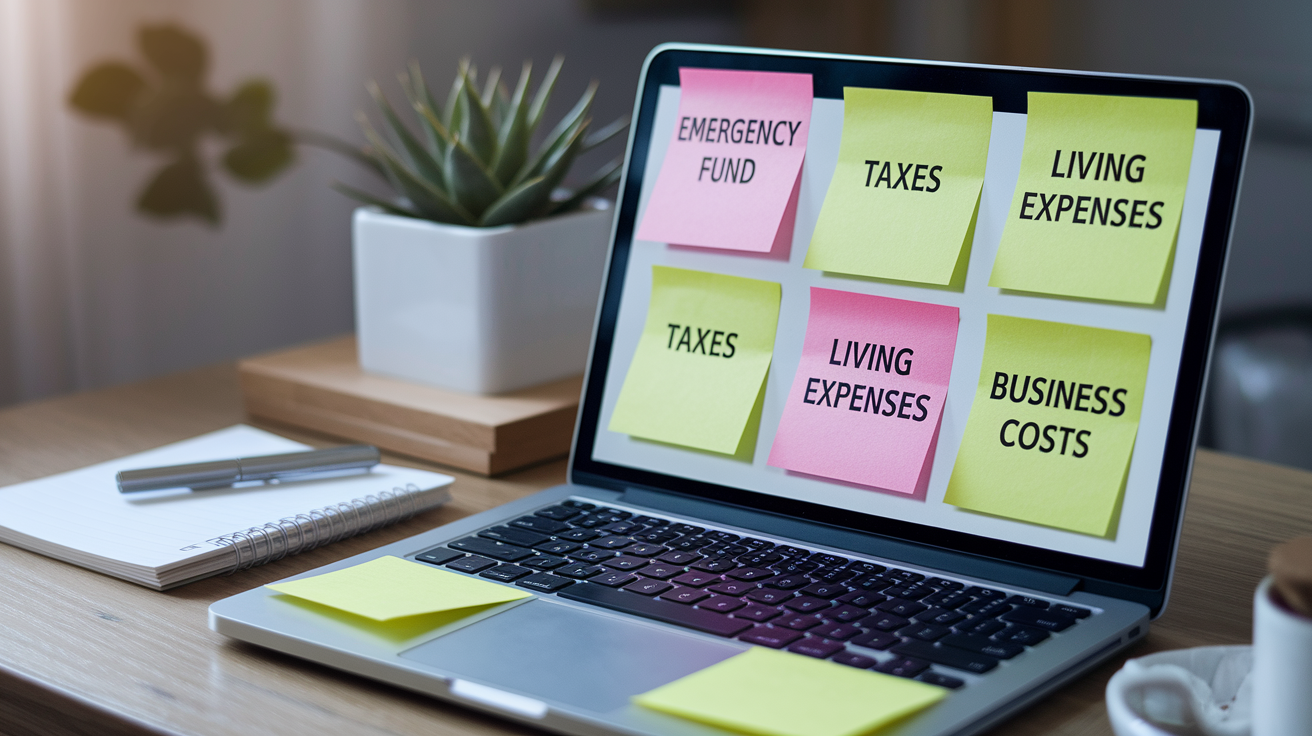
Zero-sum budgeting means living off last month’s income and assigning every dollar a job before the current month starts. Rent, insurance, utilities, subscriptions, debt payments, savings. Each gets a fixed allocation, and you don’t borrow from future paychecks to cover this month’s shortfall. That discipline prevents the cash-flow spiral where a late invoice forces you to skip an emergency-fund deposit, which leaves you exposed when the next gap arrives.
A dedicated checking account for bills helps. Deposit enough each month to cover fixed expenses: rent, insurance, utilities, loan minimums, software subscriptions. Then leave the account untouched except for those scheduled payments. The separation clarifies how much is truly available for groceries, gas, and discretionary spending. It ensures emergency-fund transfers happen before you see “extra” money in your main account.
Core Budget Categories for Freelancers
- Estimated quarterly taxes: set aside 25 to 30 percent of gross income immediately
- Essential bills: rent, utilities, insurance, phone, internet, minimum debt payments
- Emergency fund contributions: treat this as a fixed monthly bill, not a leftover
- Business operating costs: software, tools, professional development, equipment replacement reserves
- Discretionary spending: groceries, transportation, dining out, entertainment, with hard limits in lean months
Cash-flow forecasting prevents surprises. Map out expected invoice payments and known expenses for the next three months. If you see a gap (say, no major payments due in September but $3,500 in fixed costs), you know in July to either chase new work, tighten discretionary spending, or plan a smaller emergency-fund contribution that month. Forecasting turns “I ran out of money” into “I saw this coming and adjusted.”
Balancing Emergency Fund Savings with Taxes and Business Costs
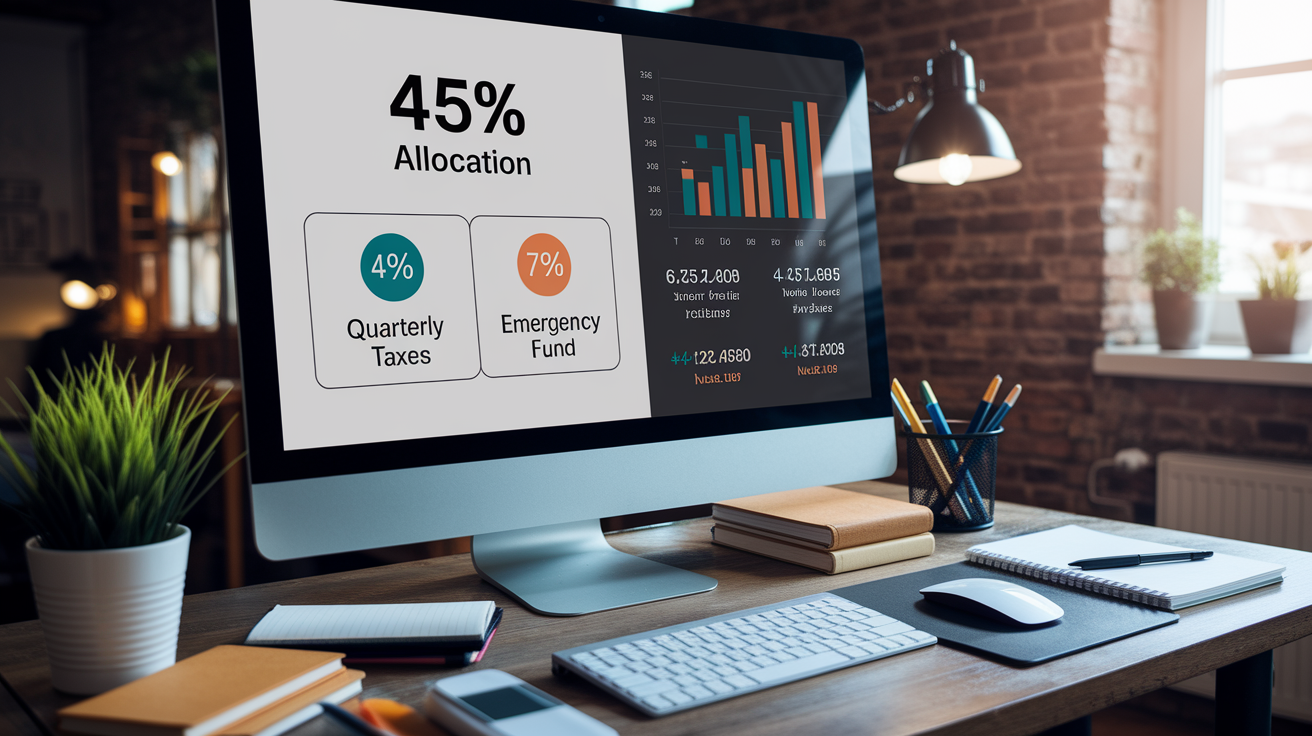
Freelancers face three simultaneous savings demands: taxes, emergency reserves, business reinvestment. A useful allocation rule is to save forty-five percent of every paycheck. Thirty percent for estimated quarterly taxes, ten percent for your emergency fund, five percent for business tools, training, or equipment. The remaining fifty-five percent covers living expenses. That breakdown ensures you don’t skip tax payments to fill your emergency fund or raid emergency savings to cover an IRS bill.
Keep tax savings and emergency savings in separate accounts. Taxes aren’t your money. They’re the government’s money waiting for the quarterly due date. Mixing the two means you’ll underestimate your true emergency cushion, and you risk spending tax reserves on a personal crisis, which creates a second crisis when the tax bill arrives. Open a high-yield savings account labeled “Quarterly Taxes” and another labeled “Emergency Fund.” Automate transfers to both immediately after each client payment.
Some months your income won’t cover the full forty-five percent allocation and living expenses. That’s exactly why you need an emergency fund. It fills the gap when last month’s deposits fall short of this month’s bills. If a slow stretch forces you to pause emergency contributions for sixty days, the fund you already built prevents panic borrowing. Resume contributions as soon as revenue recovers, even if you start at five percent instead of ten.
- Thirty percent of gross income to quarterly estimated tax savings (federal and state combined)
- Ten percent of gross income to emergency fund contributions
- Five percent of gross income to business reinvestment: new tools, courses, software upgrades, equipment reserves
- Remaining fifty-five percent for living expenses, discretionary spending, any additional savings or debt paydown
Separate your personal emergency fund from business reserves. A personal fund covers rent, groceries, health costs when client work stops. A business fund covers operating expenses (web hosting, software renewals, liability insurance) so you can keep the business running during a revenue dip without draining personal safety nets. Aim for three months of business operating costs in addition to your six to twelve month personal emergency fund. Clean bookkeeping makes the distinction clear and prevents commingling that hides true financial health.
Financial Tools Freelancers Can Use as Temporary Backups (Without Replacing an Emergency Fund)
Credit cards, personal loans, and lines of credit can bridge a short gap. But they’re not substitutes for cash reserves. A credit card buys time when an invoice is two weeks late and rent is due tomorrow, but the interest clock starts immediately. The debt compounds if the next month stays slow. Use credit only when you have a clear repayment path (an invoice about to clear, a signed contract starting next week), not as a long-term crutch for insufficient savings.
A business line of credit offers lower rates than credit cards and flexible draws, but approval requires steady revenue history and solid credit. Personal loans provide a lump sum with fixed monthly payments, which can be useful for a one-time equipment failure or medical bill. But the obligation persists regardless of future income. Both tools cost money. Both create fixed monthly outflows that tighten cash flow exactly when freelancing income is uncertain.
- Credit cards: instant access, high interest rates (often 18 to 28 percent APR), risk of minimum-payment traps in lean months
- Personal loans: fixed repayment schedule, lower rates than cards (typically 8 to 15 percent), but monthly payment is non-negotiable
- Business lines of credit: flexible draws, moderate rates, but require strong credit and revenue documentation to qualify
- Home equity lines: low rates, large limits, but put your home at risk and require income verification that may be hard during a dry spell
Build the emergency fund first. Credit is a tool for timing mismatches, covering this week’s expense while waiting for next week’s deposit. Not for surviving months of lost income. A six-month cash buffer means you never pay eighteen percent interest on groceries or risk a credit score collapse during a rough quarter.
Rebuilding and Maintaining a Freelancer Emergency Fund After Use

Restart automated contributions immediately after withdrawing from your emergency fund, even if you can only afford five percent of income instead of ten. The goal is preventing a second crisis before the first one is fully repaired. A rebuild typically takes twelve to twenty-four months to restore a three to six month cushion, depending on your income volatility and how much you withdrew.
Increase contributions during high-earning months. If a strong quarter brings in thirty percent more revenue than usual, push your emergency-fund percentage to fifteen or twenty percent for those months. The extra cash accelerates rebuilding and takes advantage of income surges that may not repeat. Track progress monthly so you see the fund growing. That reinforces the discipline when the next slow month tempts you to skip a deposit.
| Action Step | Description |
|---|---|
| Resume automated transfers | Restart contributions within one pay cycle after withdrawal, even at a reduced percentage |
| Set a rebuild target date | Calculate monthly contribution needed to restore the fund within 12 to 24 months and adjust spending to meet it |
| Boost in strong months | Temporarily increase the savings percentage when revenue spikes to accelerate replenishment |
| Review fund adequacy quarterly | Compare current fund balance to updated monthly expenses; adjust target if costs or income volatility have changed |
Review your target fund size every twelve months. If your monthly expenses climbed due to rent increases, health insurance hikes, or new business costs, recalculate the six to twelve month range and update your savings goal. If income volatility decreased (say, you signed two retainer clients that stabilize cash flow), you might comfortably move closer to the six-month end of the range instead of twelve. The fund should match your current risk, not last year’s business model.
Final Words
Start by calculating your real monthly baseline. List fixed and variable bills from bank and credit statements, then pick a starter goal: one month, then two, then three.
Automate a percentage of each payment (10–20%), keep tax and savings buckets separate, and park the fund in liquid, insured accounts like a high-yield savings or money market.
If you’re asking emergency fund for freelancers how much where to keep it, aim for 6–12 months if your income swings a lot, but begin small and build up. You’ll feel steadier and better prepared.
FAQ
Q: What is the 3 6 9 rule for emergency fund?
A: The 3 6 9 rule for emergency fund means saving 3, 6, or 9 months of living expenses depending on job stability—3 for steady pay, 6 for variable income, 9+ for high volatility or no benefits.
Q: What is the 70/20/10 rule money?
A: The 70/20/10 rule money splits take-home pay: 70% for living costs, 20% to savings (including your emergency fund), and 10% to debt repayment or extra financial goals.
Q: Where should I keep my emergency fund money?
A: Where you should keep your emergency fund money is in a liquid, insured account—high-yield savings or a money market—with same-day or next-day access and FDIC/NCUA coverage; avoid volatile or retirement accounts.
Q: How much emergency fund for self-employed?
A: How much emergency fund a self-employed person needs is typically 6–12 months of living expenses; start with 1–3 months and build toward 6–12 months based on your income swings.