


If you treat your emergency fund like an investment, you’re missing the point.
High‑yield savings accounts and money market accounts are both FDIC‑insured, but they differ in access speed, minimum balances, and fee risk.
For most people, keep the bulk of the cushion in a no‑fee high‑yield savings account for better APY and easy entry, then stash one month of expenses in checking or a money market for same‑day access.
Pick a money market only if you truly need a debit card or checks and can meet the higher minimums without fees.
Immediate Comparison: Choosing the Best Place to Keep an Emergency Fund Using High‑Yield Savings vs Money Market Accounts
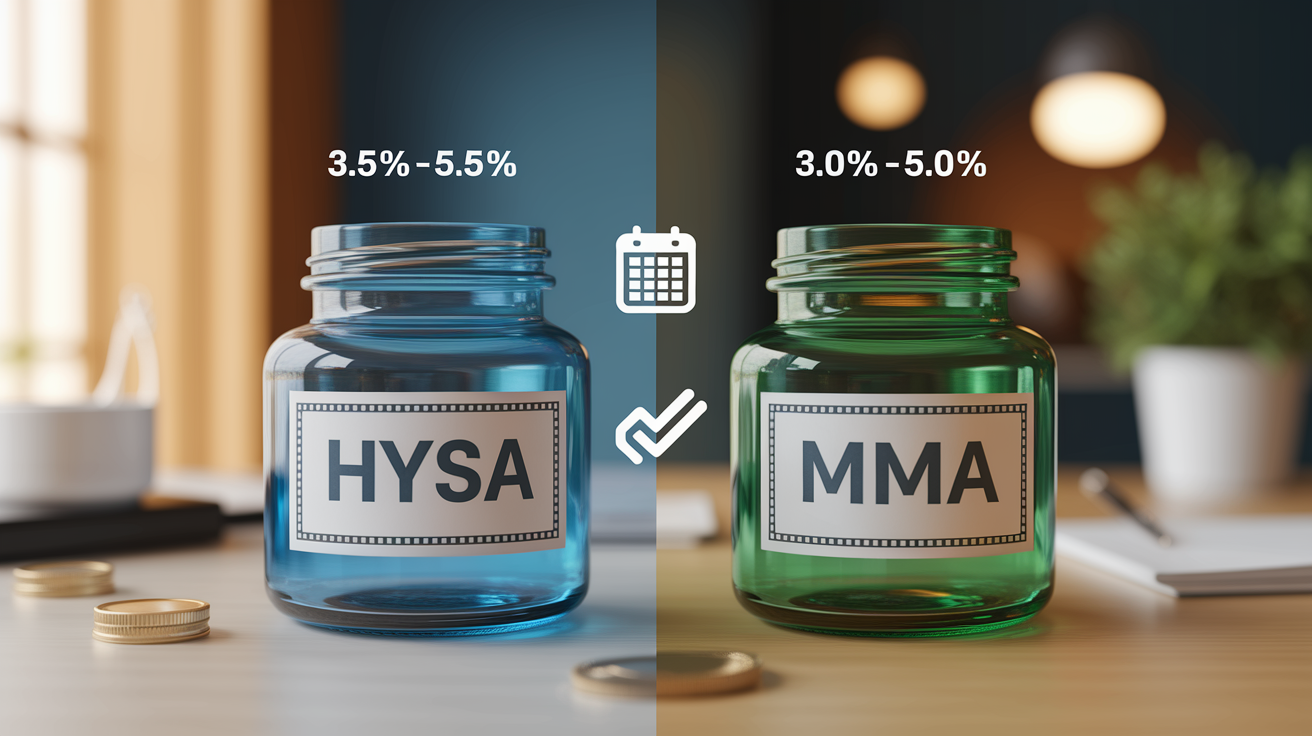
A high-yield savings account and a money market account are both FDIC-insured deposits, but they handle emergency access and earnings in different ways. As of June 2024, top online high-yield savings accounts deliver around 3.5% to 5.5% APY. Competitive money market accounts range from about 3.0% to 5.0% APY. The yield gap is usually small. The access mechanics aren’t.
Both protect your principal up to $250,000 per depositor, per insured institution, per ownership category under FDIC or NCUA coverage. The real difference is how you get your money out. Money market accounts typically come with check-writing, debit cards, and ATM access. You can spend or withdraw cash right away. High-yield savings accounts make you transfer funds via ACH to a linked checking account first. That adds one to three business days before you can actually use the money.
The Federal Reserve removed the mandatory six-withdrawal cap in April 2020 under Regulation D. But many banks still enforce internal limits or charge fees when you go over roughly six outbound transfers per month. High-yield savings accounts often require $0 to $100 minimum balances and carry minimal monthly fees. Money market accounts frequently demand $1,000 to $10,000 minimums and may hit you with $5 to $15 monthly charges if your balance drops below the line.
Best for highest APY on small balances: Pick a no-fee online HYSA with zero or low minimums.
Best for immediate debit or check access: Go with an MMA if you can maintain the required minimum and live with potential fee risk.
Best for balances above $250,000: Split funds across multiple FDIC-insured banks or use different ownership categories to keep full insurance.
Best for most typical savers: Park one month of expenses in checking or an MMA for instant access. Keep the rest in an online HYSA for better yield.
Use a high-yield savings account when you want top earnings, can accept one-to-three-day transfer times, and appreciate minimal barriers to entry. Choose a money market account when you need a debit card or checkbook for emergency purchases and can meet higher balance thresholds without triggering fees.
Understanding What Makes an Emergency Fund Effective

An emergency fund exists to cover unexpected expenses without forcing you to borrow or sell off long-term investments. Medical bills, car repairs, job loss. Financial planners usually recommend three to six months of living expenses in cash for most households. Six to twelve months for self-employed people or anyone with volatile income. If your monthly expenses run $3,000, you’re looking at $9,000 to $18,000.
The guiding principle is liquidity first, safety second, yield third. Your emergency cash needs to be accessible within hours or a few business days, can’t lose principal value, and should earn some interest to fight inflation. But earning maximum returns is the lowest priority because the primary job here is insurance, not investment.
Principal protection: Choose accounts backed by FDIC or NCUA insurance so your balance can’t drop below what you deposited.
Immediate or near-immediate availability: Funds should be reachable in one to three business days at most. Ideally portions are accessible same-day.
Low or zero fees: Monthly maintenance charges and excessive-withdrawal penalties eat into your cushion and complicate budgeting.
Competitive interest rate: Even modest APY helps your fund keep pace with inflation. A 4% account earns $360 per year on $9,000, versus $4.50 at 0.05%.
Separation from daily spending: Keeping emergency money distinct from checking reduces impulse use and preserves the fund for true emergencies.
High-yield savings accounts and money market accounts meet all five criteria when structured correctly. Both are deposit accounts insured by the federal government. Both offer competitive yields compared to traditional savings or checking. Both allow withdrawals without early-withdrawal penalties common to certificates of deposit. The choice comes down to how you balance access speed against yield optimization and minimum-balance rules.
High‑Yield Savings Account Features That Add Unique Value

Online banks dominate the high-yield savings landscape because they skip branch overhead and pass the savings to depositors through APYs in the 3.5% to 5.5% range. These accounts compound interest daily or monthly and credit earnings monthly. A $10,000 balance at 4.5% APY generates approximately $450 per year with no extra effort. Most online HYSAs impose no monthly maintenance fees and require minimal opening deposits, often $0 to $100. This makes them accessible even to new savers building their first emergency reserve.
Because online banks don’t have physical branches, high-yield savings accounts rarely offer debit cards or check-writing. You link the account to an external checking account and initiate ACH transfers to move money. Transfers between accounts at the same institution clear instantly. But moving funds from your online HYSA to a checking account at a different bank typically takes one to three business days. This delay creates natural spending friction that helps preserve emergency funds for genuine crises rather than impulse purchases.
| Feature | Typical Value | Impact on Emergency Fund |
|---|---|---|
| APY leadership | 3.5%–5.5% (June 2024) | Maximizes interest earnings on idle cash reserves; $20,000 at 4.5% earns ~$900/year vs ~$100 at 0.5%. |
| Digital-only structure | Mobile app, web portal, no branches | 24/7 account monitoring and transfer initiation; one-to-three-day ACH delay acts as guardrail against non-emergency spending. |
| Low minimums | $0–$100 to open; $0 ongoing balance requirement | No risk of fees wiping out interest; accessible to small savers and those rebuilding after using reserves. |
A high-yield savings account works particularly well when your emergency fund sits untouched for months at a time, you maintain a separate checking account for daily transactions, and you value simplicity and yield over immediate debit access. The enforced transfer step ensures you pause before tapping the fund. The superior APY means inflation erodes purchasing power more slowly.
Money Market Account Benefits That Stand Out for Emergency Access

Money market accounts blend savings-account yields with checking-account transaction tools. Many MMAs issue debit cards, allow ATM withdrawals, and provide a limited number of checks per month. You can pay a mechanic, withdraw cash for a co-pay, or cover an urgent expense without waiting on ACH settlement. This immediacy is the core MMA advantage. When your car breaks down on a Saturday, you can hand the repair shop a check or swipe your MMA debit card rather than waiting until Tuesday for an external transfer to clear.
APYs on money market accounts often tier by balance. You might earn 3.0% on balances under $5,000, 4.0% between $5,000 and $25,000, and 4.5% above $25,000. Higher tiers can rival or occasionally beat top online HYSAs, but only if you maintain the required minimum. Many institutions charge $10 to $15 per month when your balance dips below the threshold, say $2,500 or $10,000. That can erase months of interest if you tap the account during an emergency and forget to restore the minimum quickly.
Check-writing capability: Write checks directly from the MMA to pay contractors, medical providers, or other payees who prefer paper checks. No need to transfer funds first.
ATM convenience: Withdraw cash at ATMs using your MMA debit card, handy for emergencies that require immediate physical currency.
Balance-tier APYs: Earn higher rates on larger balances, but be aware that falling below the tier cutoff can drop your yield significantly mid-month.
Fee risks: Monthly maintenance fees kick in if your balance falls short. Always confirm the fee schedule and tier thresholds before opening.
Debit-card availability: Swipe your card for emergency purchases like plane tickets home or urgent supplies without delay.
Ideal emergencies: Best suited for scenarios requiring same-day payment. Hospital bills, emergency travel, or repair services that don’t accept ACH.
Money market accounts work best for savers who can comfortably maintain the minimum balance, value the psychological comfort of instant access, and want a single account that combines competitive yield with transactional flexibility. If your emergency fund is large enough to stay above the tier cutoff even after a typical emergency withdrawal, the MMA’s access tools may justify accepting a slightly lower APY than the top online HYSA.
APY, Liquidity, and Access Comparison: High‑Yield Savings vs Money Market
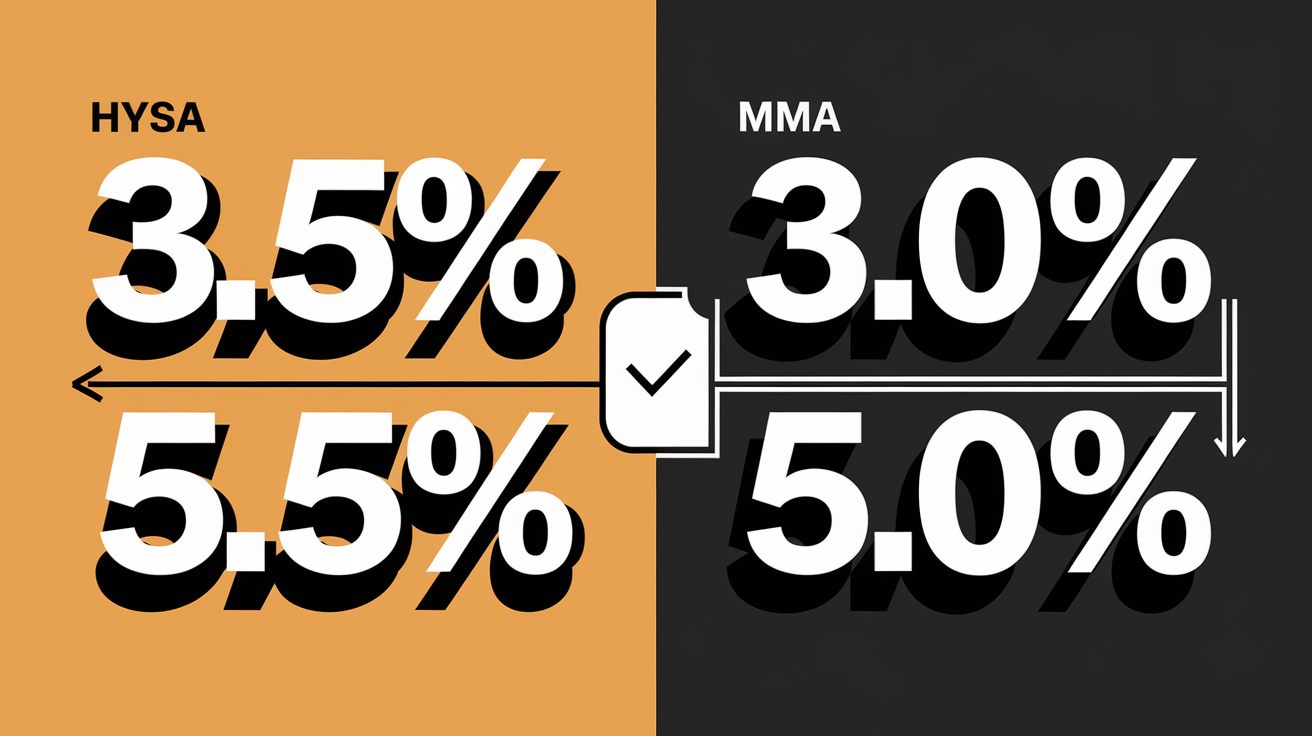
Direct comparison reveals where each account type excels and where trade-offs emerge.
| Category | HYSA | MMA |
|---|---|---|
| APY range (June 2024) | 3.5%–5.5% | 3.0%–5.0%, often tiered by balance |
| Minimum to open / earn top rate | Typically $0–$100; top rate available at all balances | Often $1,000–$10,000 to open or unlock top tier |
| Monthly fees | Usually $0 | $5–$15 if balance falls below minimum |
| Access methods | ACH transfer to linked checking (1–3 business days); some allow internal instant transfers if checking is at same bank | Debit card, ATM, check-writing, plus ACH (1–3 days for external) |
| Withdrawal restrictions | No federal cap since Apr 2020; some banks impose ~6-transfer monthly limits or fees | Same federal change; banks may limit checks/debits to ~6 per month or charge for excess |
| Compounding frequency | Daily, credited monthly (typical) | Daily, credited monthly (typical) |
On pure yield, online high-yield savings accounts often lead by 0.25% to 1.0% APY because digital-only banks have lower operating costs. That spread translates to real dollars. $10,000 at 4.5% APY earns approximately $450 per year. The same balance at 3.5% earns $350, a $100 annual difference. Over three years, the HYSA generates an extra $300 in interest, assuming rates hold steady.
Liquidity differences center on speed. Both account types settle external ACH transfers in one to three business days. If your MMA and your rent-paying checking account sit at different banks, you face the same delay whether you start the transfer from an HYSA or an MMA. The MMA’s advantage appears only when you can use its debit card or write a check directly, spending the emergency money without a transfer step. Internal transfers, when your HYSA or MMA shares a bank with your checking account, usually post instantly for both account types, erasing the access gap.
Compounding mechanics are nearly identical. Both account types apply daily compounding and credit interest monthly. The effective yield matches the stated APY as long as you maintain a steady balance. Choose based on whether you value the 0.5% to 1.0% higher APY from a top HYSA or the immediate-access tools of an MMA, because liquidity speed and yield are the only material differences once you account for fees and minimums.
Insurance, Safety, and Risk: How Protected Is Your Emergency Fund?

FDIC insurance covers up to $250,000 per depositor, per insured bank, per ownership category. If you hold an individual HYSA with $200,000 at Bank A and a joint account with $300,000 at the same bank, the individual account is fully insured. The joint account is insured up to $500,000 total because joint accounts receive $250,000 per co-owner. NCUA provides equivalent protection for credit-union members. Both high-yield savings accounts and money market accounts at FDIC or NCUA member institutions carry this coverage, so principal risk is effectively zero up to the cap.
Money market accounts are deposit products and must not be confused with money market mutual funds, which are brokerage investments that hold short-term debt securities like Treasury bills and commercial paper. Money market mutual funds aren’t FDIC-insured. They’re covered, if held at a brokerage, by SIPC up to $250,000 for cash claims. But SIPC protects against broker failure, not investment losses. During the 2008 financial crisis, one prominent money market mutual fund “broke the buck,” dropping below $1.00 net asset value per share. That showed these funds carry credit and interest-rate risk absent from insured deposit accounts.
For emergency funds exceeding $250,000, preserve full insurance by splitting deposits across multiple banks or using different ownership categories (individual, joint, trust, retirement). Some cash-management services and brokerage sweep programs automatically distribute deposits across a network of banks, each holding less than $250,000 of your total. This extends FDIC coverage to several million dollars. Verify that any sweep program uses genuine FDIC member banks and that each sub-account is titled correctly to trigger separate insurance limits.
Expanding FDIC Coverage for Large Emergency Reserves
If you need to hold $500,000 in cash, open individual accounts at two separate FDIC member banks, placing $250,000 in each. Or structure a $250,000 individual account and a $250,000 joint account (with a spouse or partner) at the same institution. That uses two ownership categories and thus two separate insurance pools. Trusts, payable-on-death accounts, and retirement accounts each create additional categories. But emergency funds are usually held as individual or joint deposits for simplicity. Always confirm coverage using the FDIC’s Electronic Deposit Insurance Estimator before finalizing large deposits. Titling errors or account misconfiguration can reduce actual protection below the theoretical maximum.
Withdrawal Rules, Fees, and Minimum Requirements That Affect Your Emergency Fund
In April 2020, the Federal Reserve eliminated the six-withdrawal monthly limit previously required under Regulation D for savings deposits. This change is permanent at the regulatory level. Banks aren’t federally required anymore to convert savings accounts into checking accounts or restrict electronic transfers to six per month. Individual banks still retain the right to impose their own policies. Many still limit outbound ACH transfers, online bill payments, and automatic transfers to approximately six per statement cycle. They charge fees, often $5 to $10 per excess transaction, or convert the account type if you repeatedly exceed the cap.
Money market accounts historically shared the same Regulation D restriction. Post-2020, most MMAs allow unlimited debit-card purchases and ATM withdrawals because those are classified as point-of-sale transactions rather than “convenient” transfers. But check-writing and ACH transfers may still face internal bank limits. Always review the account’s fee schedule and transaction rules before opening. Some banks clearly state “unlimited transactions.” Others quietly enforce legacy caps and penalize excess activity.
Internal transfer caps: Even after Reg D repeal, expect around six outbound electronic or check transfers per month at many institutions. Confirm whether your bank charges fees or simply warns you.
Minimum-balance thresholds: HYSAs typically require $0–$100. MMAs often need $1,000–$10,000 to avoid monthly fees or earn top-tier APY.
Monthly maintenance fees: Common MMA fee is $10–$15/month if balance falls below minimum. HYSA fees are rare but verify before opening.
Excessive-withdrawal penalties: Some banks charge $5–$10 per transaction beyond the sixth. Repeated violations can trigger account closure or forced conversion to checking.
ATM and debit fees: MMAs may offer free ATM access within network but charge $2–$3 per out-of-network withdrawal. HYSAs rarely issue debit cards, so ATM fees are moot.
Fees can quietly cancel yield. A $10 monthly fee costs $120 per year. On a $10,000 balance earning 4% APY, that fee consumes 30% of your $400 annual interest. For emergency funds under $5,000, even a single monthly fee wipes out most earnings. Prioritize accounts with no monthly maintenance charges and verify that the account remains fee-free if your balance temporarily dips after an emergency withdrawal.
Scenario‑Based Examples: How Different Savers Choose Between HYSA and Money Market Accounts
Different life situations call for different mixes of yield and access.
New Saver Building a First Emergency Fund (Under $1,000)
You just started saving and have $800 set aside. Your priority is safety, easy deposits, and avoiding fees while the balance grows. Open a no-fee online high-yield savings account with a $0 minimum. Many offer 4.0% to 5.0% APY regardless of balance size. Link it to your checking account and set up a $100 automatic monthly transfer.
Choose an HYSA with zero minimums and no monthly fees to avoid losing money to account charges.
Accept the one-to-three-day ACH transfer delay because emergencies under $1,000 can usually wait or be covered temporarily by a credit card, then repaid from the HYSA.
Monitor the balance monthly and increase transfers as income allows until you reach at least one month of living expenses.
This setup maximizes your APY from day one, costs nothing to maintain, and builds the discipline to keep emergency money separate from daily spending.
Typical Saver with 3–6 Months of Expenses ($9,000–$18,000)
Your monthly expenses are $3,000, so you’re targeting $9,000 to $18,000 in reserves. You want high yield on the bulk of the fund but need some cash available immediately for urgent bills. Split your fund into two pieces. Keep $3,000 (one month) in your checking account or a money market account with debit access. Park the remaining $6,000 to $15,000 in an online HYSA earning top APY.
Maintain $3,000 in a no-fee checking account or MMA with a debit card so you can cover an emergency expense without waiting on transfers. Car repair, medical co-pay, urgent flight.
Deposit the remaining $6,000–$15,000 into a high-yield savings account at a different bank to earn 4.5% APY (approximately $270–$675 per year) and create friction against non-emergency spending.
Replenish the accessible $3,000 buffer within 30 days after any emergency withdrawal by transferring from the HYSA, then rebuild the HYSA over subsequent months.
This two-tier strategy balances immediate liquidity with maximum interest. The geographical separation (different banks) reduces temptation to raid the HYSA for routine expenses.
Self-Employed or Irregular Income (6–12 Months of Expenses, $18,000–$36,000)
Freelance income fluctuates, so you hold $30,000 to cover slow months and unexpected gaps. You need both high yield and the ability to access chunks of money quickly when invoices arrive late. Combine three tools. One month ($3,000) in checking, two months ($6,000) in an MMA with check-writing, and the rest ($21,000) in an HYSA or laddered short-term Treasury bills.
Keep $3,000 in checking for routine bills and small emergencies.
Place $6,000 in a money market account with debit/check access so you can write a check for quarterly taxes or bridge a cash-flow gap without ACH delays. Choose an MMA that pays at least 3.5% APY and has a reasonable minimum (e.g., $2,500) you can maintain even after withdrawing $3,000.
Invest the remaining $21,000 in a high-yield savings account earning 4.5%–5.0% APY, or ladder it into four-week Treasury bills if you want slightly higher yield and are comfortable with settlement timing. T-bills settle via your brokerage, typically next-day liquidity but not instant debit access.
This three-layer structure ensures you always have $9,000 reachable within minutes to hours, $21,000 available in one to three days, and every dollar earns competitive interest while idle.
Advanced Approaches: Combining HYSA and Money Market Accounts for Maximum Flexibility
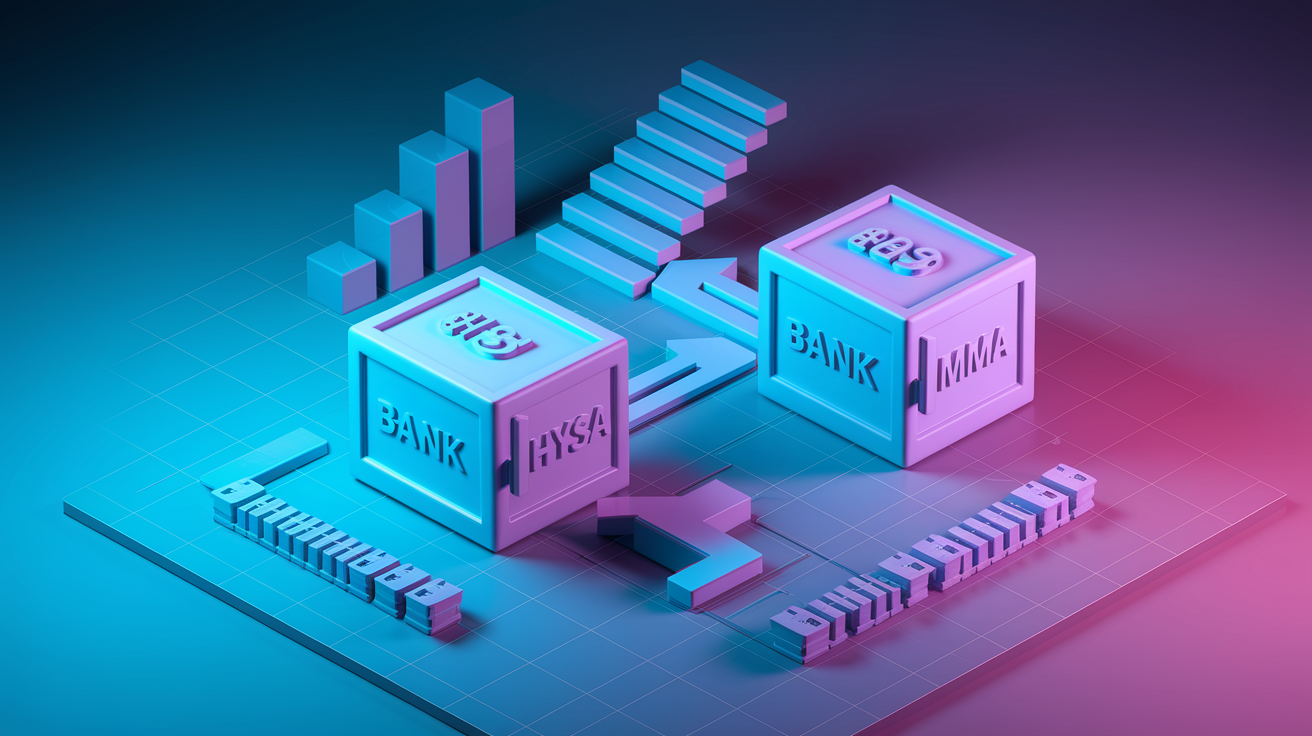
Holding both account types lets you optimize for different needs simultaneously. Allocate one month of expenses to a money market account with debit access for true emergencies requiring immediate payment. Think hospital bills, emergency travel, or urgent home repairs. Place the remaining months in a high-yield savings account at a separate institution to capture top APY and prevent impulsive transfers. When you tap the MMA during an emergency, initiate a transfer from the HYSA to restore the MMA buffer within a few days, keeping both accounts active and balanced.
This dual-account system also spreads FDIC coverage. If your total emergency fund is $200,000, deposit $150,000 into Bank A’s HYSA and $50,000 into Bank B’s MMA, ensuring both balances stay under the $250,000 insurance cap. You gain diversification across institutions and avoid the administrative complexity of joint accounts or trust titling. You maintain instant debit access on the MMA portion and superior yield on the HYSA portion.
One-month buffer in MMA, rest in HYSA: Covers immediate needs without sacrificing yield on the bulk of reserves.
Split between two banks for FDIC coverage: Protects balances above $250,000 and reduces single-institution risk.
HYSA at online bank, MMA at local credit union: Combines best-in-class APY with in-person branch support if you need to deposit large checks or resolve account issues face-to-face.
Laddered short-term CDs or Treasury bills for portion above six months’ expenses: If you hold twelve months of reserves, keep six months liquid (three in MMA, three in HYSA) and ladder the remaining six into three-month or six-month instruments for incrementally higher yield. Accept that early redemption may incur small penalties or settlement delays.
For very large emergency funds, $500,000 or more, consider cash-management accounts offered by brokerages that sweep deposits across multiple FDIC member banks automatically. These programs can insure up to several million dollars by fragmenting your balance into $250,000 chunks across different banks, each separately insured. Verify the program’s structure, confirm daily liquidity via ACH or wire, and ensure the sweep banks are genuine FDIC members, not uninsured affiliates. This approach combines maximum insurance, competitive yield, and centralized management. Though you lose the immediate debit-card access of a traditional MMA.
Practical Steps and Account‑Opening Checklist for Your Emergency Fund Setup

Opening a high-yield savings account or money market account takes fifteen to thirty minutes online. You’ll need a government-issued photo ID (driver’s license or passport), your Social Security number, current address, and an external bank account to fund the new account via ACH transfer.
Compare current APYs, minimums, and fees across at least three institutions. Use bank comparison sites or check each bank’s website directly to confirm rates as of today.
Verify FDIC or NCUA membership by searching the institution name on the FDIC BankFind tool or NCUA’s credit-union locator. Never assume insurance without checking.
Review the fee schedule and transaction limits in the account’s terms and conditions. Confirm whether the bank enforces withdrawal caps or charges monthly maintenance fees if your balance falls below a threshold.
Gather required documents. Photo ID, SSN, proof of address (utility bill or lease if requested), and the routing and account numbers for your existing checking account.
Complete the online application and choose whether to open an individual or joint account. Joint accounts double FDIC coverage per institution but require both owners to manage access.
Link your external checking account and initiate the first deposit. Initial ACH transfers typically take two to four business days to settle and verify micro-deposits before full access is enabled.
Set up mobile app login, enable two-factor authentication, and review notification settings to monitor withdrawals and catch unauthorized transactions immediately.
Before relying on the new account, test a small withdrawal to confirm ACH timing and verify that funds arrive in your checking account as expected. Check the mobile app’s interface for ease of initiating transfers, viewing balances, and accessing customer support. Strong app reliability and fraud-detection features matter for emergency funds because you may need to move money quickly during stressful situations. Clunky apps or unresponsive customer service create friction when you can least afford it.
Final Words
You weighed APY, access speed, insurance, fees, and minimums to compare high-yield savings and money-market accounts.
Short version: HYSAs usually give higher rates and lower minimums. MMAs offer debit/check/ATM access and can be better for immediate needs. Both are FDIC/NCUA insured up to limits, so safety is similar.
If you still wonder the best place to keep emergency fund high yield savings vs money market, aim for liquidity first: one month in an MMA or checking and the rest in a HYSA.
You’ll end up with an insured, usable buffer that earns more.
FAQ
Q: Should my emergency fund be in a high yield savings account?
A: The emergency fund should be in a high yield savings account when you want insured liquidity and a higher APY with low minimums; choose a money market if you need immediate debit/check access, since transfers often take 1-3 business days.
Q: What is the 3 6 9 rule for emergency fund?
A: The 3‑6‑9 rule for emergency funds recommends three to six months of essential expenses for most people, and extending to nine months (or six to twelve) if your income is unstable or you’re self‑employed.
Q: What is safer, a money market or a high yield savings account? Where is the safest place to keep emergency fund?
A: The safest place to keep an emergency fund is an FDIC/NCUA-insured bank or credit union account; both high‑yield savings and bank money market accounts are covered up to $250,000 per depositor. Money market mutual funds aren’t insured.