


The “pay the smallest debt first” approach feels good, but it can cost you thousands.
If you’re juggling three or more loans with different APRs and due dates, it becomes a calendar and math problem, not a simple choice.
Missed payments, late fees, and decision paralysis are the usual results.
This post gives a clear, step-by-step framework to inventory every loan, pick a prioritization rule, calculate realistic payoff timelines, and test whether consolidation saves money.
You get a monthly plan that removes guesswork, shows the tradeoffs, and gives simple next steps to actually finish.
Building a Structured Multi‑Loan Repayment System

Managing three, four, or five separate loan payments creates a practical problem: every account has a different APR, due date, and minimum you’re on the hook for. Without a written system, you’re stuck holding every detail in your head. That leads to missed payments, late fees, and the kind of decision paralysis that makes you avoid logging into your accounts altogether.
A structured multi‑loan repayment framework removes that cognitive load. You get a repeatable plan that you execute once per month.
The foundation is a complete inventory. You need to see every debt in one place before you can decide which account gets extra payments. The inventory turns an overwhelming cloud of obligations into a simple list with numbers you can actually compare.
The core steps:
Create a full debt list with balances, APRs, minimums, and due dates. Choose a prioritization strategy (snowball or avalanche). Commit to paying all minimums on every account, every month. Assign all extra payment capacity to one target debt. Set monthly review checkpoints to track progress and adjust when things change.
Two methods dominate prioritization decisions. The debt snowball targets your smallest balance first. Quick wins, momentum, psychological fuel. The debt avalanche targets your highest APR first. Less interest paid, lower total cost. Both work if you execute the plan consistently and don’t take on new debt during repayment.
Organizing Loan Details for a Clear Debt Repayment Framework

You can’t prioritize debts if the details live in your email inbox, billing apps, and memory. Building a single spreadsheet that captures every loan puts the full picture in one row‑by‑row view. It makes it possible to model what happens when you add $200 or $400 to a specific account.
Expect this initial work to take about an hour. Once complete, monthly updates take five minutes.
Each row should include the debt name, account type, outstanding balance, APR, minimum monthly payment, next due date, target payoff order (based on your chosen strategy), the extra payment amount you plan to direct to that debt, your estimated payoff date, interest paid to date, and notes for any special terms or penalties.
The balance and APR drive your prioritization decision. The minimum payment protects you from penalties and credit damage. The due date prevents missed payments. The target order column tells you which debt receives extra funds this month. The estimated payoff date keeps your motivation realistic. It prevents burnout from underestimating timelines.
| Column Name | Purpose |
|---|---|
| Balance | Determines remaining principal and payoff timeline |
| APR | Drives interest cost and avalanche prioritization |
| Minimum Payment | Protects credit and prevents late fees |
| Due Date | Prevents missed payments and timing errors |
| Extra Payment | Tracks discretionary funds allocated to accelerate payoff |
Understanding Debt Prioritization Strategies for Multiple Loans

When you have multiple debts and limited extra cash each month, you need a rule that tells you which account gets the surplus. Without that rule, you split payments across every loan. That slows every payoff and delivers no psychological wins.
Picking one prioritization method and sticking to it is what converts scattered effort into measurable progress.
Using the Snowball Approach
The snowball method targets the smallest balance first, regardless of APR. You pay minimums on all other accounts and throw every extra dollar at the debt with the lowest principal. Once that account reaches zero, you roll its full monthly payment into the next smallest balance.
The example scenario: Card B at $1,200 and 18% APR, Card A at $5,000 and 20% APR, car loan at $12,000 and 6% APR. You’d tackle them in that order. Card B, then Card A, then the car loan.
If you have $400 extra each month, you send $440 total to Card B (its $40 minimum plus $400 extra), paying it off in roughly three months. Then you redirect that $440 into Card A for a combined $560 monthly payment, clearing it in about ten months. Finally, the $560 rolls into the car payment for a total of $860 per month, finishing the car in approximately fifteen months.
Total time is around 28 months.
Using the Avalanche Approach
The avalanche method targets the highest APR first to minimize total interest paid over the life of the repayment plan. Using the same three debts, you’d attack Card A first because its 20% APR is the highest.
You pay its $120 minimum plus the $400 extra for a total of $520 per month, clearing it in roughly eleven months. Then you roll that $520 into Card B for a combined $560 monthly payment, paying it off in two to three months. The $560 moves to the car loan for a total of $860 per month, finishing in about fifteen months.
Total time is also around 28 months in this example, though the interest saved depends on the exact APR spread and balance mix.
In this particular scenario, both methods take similar time because the highest‑APR debt is also the second‑largest balance. When the highest‑rate debt is tiny, snowball and avalanche converge. When the highest‑rate debt is also the largest, avalanche saves more interest but delays the first payoff milestone.
You can also build a hybrid: knock out one small debt for momentum, then switch to avalanche for the rest.
Calculating Timelines Within a Multi‑Loan Repayment Framework

Guessing when each loan will reach zero creates false hope and prevents realistic planning. Calculating payoff timelines tells you whether your current monthly extra payment will finish all debts in two years or five. And whether adjusting that amount by $100 makes a material difference in outcome.
The process involves four steps:
Calculate monthly interest for each debt. Take the balance and multiply by APR divided by twelve. Identify your total monthly discretionary cash available for debt repayment above minimums. Apply the months‑to‑payoff formula for each account: n = -ln(1 – rP/A) / ln(1 + r), where r is monthly interest rate (APR/12), P is principal, and A is total monthly payment. Compare total interest paid under snowball, avalanche, and any hybrid variations to choose the lowest‑cost path.
Using the three‑debt example, if you send $440 per month to Card B at 18% APR with a $1,200 balance, the monthly interest rate is 0.015 (18% / 12), and the formula yields approximately three months to payoff. If you instead send $520 to Card A at 20% APR with a $5,000 balance, the calculation shows roughly eleven months. The car loan at 6% APR and $12,000 balance, receiving $860 per month after the cards are cleared, finishes in about fifteen months.
Summing the sequential timelines gives you the total repayment period.
Most borrowers use a spreadsheet or online payoff calculator to run these numbers rather than calculating logarithms by hand. The important outcome is seeing how different monthly payment amounts and debt orders affect your finish date. So you can decide whether cutting another $50 from your budget shortens the timeline enough to be worth the effort.
Consolidation Options Within a Multi‑Loan Debt Repayment Framework

Consolidation converts multiple separate loans into a single new loan with one monthly payment and one due date. It simplifies calendar management and can lower your weighted average interest rate if you qualify for better terms than your existing debts carry.
Consolidation makes the most sense when you have stable income, good enough credit to qualify for a lower APR than your current mix, and the discipline to avoid running up balances on the accounts you just paid off.
Six factors shape whether consolidation improves your situation:
Origination fees. Personal loans often charge one to eight percent upfront, which reduces the net benefit of a lower rate. Collateral requirements. Larger consolidation loans may require a lien on a vehicle, raising foreclosure or repossession risk if you miss payments. Balance‑transfer fees. Credit card promotional offers typically charge three to five percent of the transferred amount. APR variations. Your approved rate depends on credit score, income, and state. A consolidation loan at 15% APR helps if your cards are at 20% but not if your existing debts average 10%. Term extension risk. Stretching a 24‑month payoff into 60 months lowers monthly obligations but increases total interest paid. Qualification limits. Lenders cap loan amounts and impose debt‑to‑income ratio requirements. Some states set minimum loan sizes (for example, Alabama $2,100, California $3,000) and maximums (North Carolina $11,000 unsecured, West Virginia $13,500).
Refinancing differs slightly: you replace one specific loan with a new loan at better terms, rather than bundling multiple debts. For example, refinancing a car loan from 12% to 6% cuts monthly interest without touching your credit card balances.
A $6,000 consolidation loan at 24.99% APR for 60 months results in monthly payments of $176.07, totaling $10,564 over the life of the loan. Compare that total to the sum of interest you’d pay on your current debts under snowball or avalanche to see which path costs less.
Lenders evaluate your application based on income after monthly expenses, credit history, and available collateral. Highly qualified applicants receive lower APRs and higher loan amounts. Active‑duty military borrowers and their dependents covered by the Military Lending Act face restrictions on pledging vehicles as collateral, which narrows product options.
Always request prequalification to see rates and terms without triggering a hard credit inquiry.
Budget Allocation Methods to Support a Multi‑Loan Repayment Plan
Finding extra money for debt payoff starts with understanding where your income currently goes. A monthly cash‑flow analysis separates essentials (rent, utilities, groceries, insurance, minimum debt payments) from discretionary spending (subscriptions, dining out, entertainment). Then identifies dollars you can redirect without creating new financial stress.
Even small amounts compound: $25 per month for 24 months is an extra $600 toward principal.
Five practical steps to free up cash:
Audit all subscriptions and recurring charges. Cancel services you forgot about or rarely use. Cut one discretionary category temporarily. Skip takeout twice per month, pause a gym membership, or delay non‑urgent purchases. Negotiate recurring bills. Call internet, phone, and insurance providers to request lower rates or competitor‑match pricing. Lower variable spending by setting weekly cash or debit‑card limits for non‑essential categories. Redirect windfalls. Tax refunds, bonuses, or side‑income payments go straight to the target debt rather than into general spending.
Zero‑based budgeting ensures every dollar has a job before the month starts. You assign income to categories until you reach zero unallocated dollars, forcing intentional choices about debt repayment versus other goals.
In a zero‑based framework, your budget includes lines for essentials, minimum payments on all debts, the fixed extra payment to your target debt, and a small emergency buffer (typically $500 to $1,000) to prevent new borrowing when unexpected expenses arise. The emergency fund protects the repayment plan from derailment, but it should remain small enough that you don’t delay debt payoff for years while building a large savings cushion.
Automation, Progress Tracking, and Maintaining Momentum in a Multi‑Loan Framework

Relying on memory to make payments on time across multiple due dates creates unnecessary risk. One missed payment triggers a late fee, raises your APR, and damages your credit score.
Automation removes that risk by scheduling payments before the due date every month. Most lenders offer autopay for at least the minimum payment, and some reduce your interest rate by 0.25% when you enroll. Set autopay for minimums on all accounts, then manually send the extra payment to your target debt each month after confirming your budget allows it.
Visual progress systems make abstract debt reduction feel real. A simple progress bar for each loan, updated weekly or monthly, shows the shrinking balance and reminds you that the plan is working.
Some borrowers use a printed payoff board with one box per $100 or $500 of debt. Color in a box every time you make an extra payment. Others track cumulative interest saved under avalanche versus what they would have paid without a plan. The specific tool matters less than the habit of reviewing progress regularly.
Set small milestone celebrations that don’t involve spending money you need for debt repayment. When you pay off the first loan, take an afternoon off, cook a favorite meal, or mark the date on a calendar.
Monthly review checkpoints, scheduled for the same day each month, let you confirm that minimums posted, adjust the extra payment amount if income changed, and update your payoff timeline if you paid more or less than planned. These reviews also surface problems early, like a missed autopay or an unexpected fee, so you can fix them before they cascade.
Example Case Study Illustrating a Multi‑Loan Debt Repayment Framework
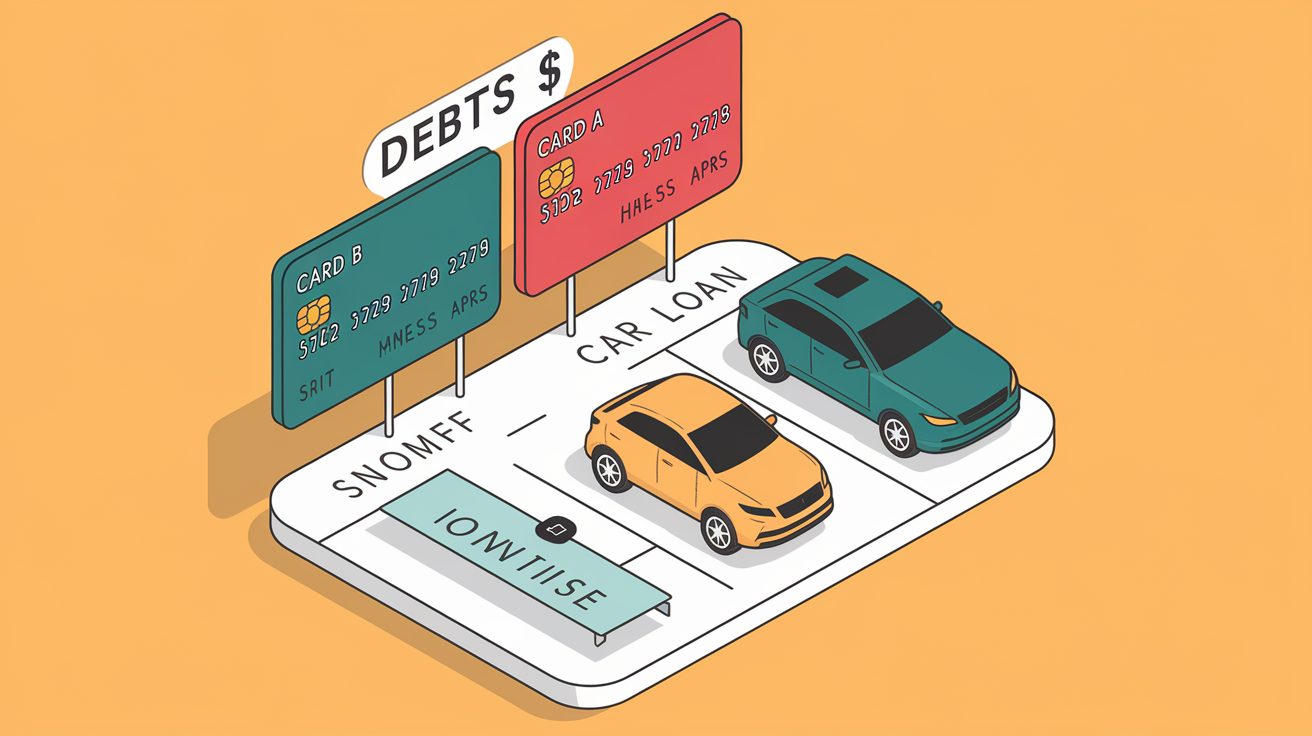
A borrower carries three debts: Card B with a $1,200 balance at 18% APR, Card A with a $5,000 balance at 20% APR, and a car loan with a $12,000 balance at 6% APR. Minimum payments are $40, $120, and $300, respectively. After covering essentials and minimums, the borrower has $400 per month available for extra debt repayment.
| Debt | Balance | APR | Snowball Order | Avalanche Order |
|---|---|---|---|---|
| Card B | $1,200 | 18% | 1 | 3 |
| Card A | $5,000 | 20% | 2 | 1 |
| Car Loan | $12,000 | 6% | 3 | 2 |
Under the snowball method, the borrower clears Card B in three months, then Card A in ten months, then the car loan in fifteen months, for a total of approximately 28 months.
Under the avalanche method, the borrower pays Card A in eleven months, Card B in two to three months, then the car loan in fifteen months, also totaling around 28 months.
In this scenario, avalanche saves a modest amount of interest because the 20% APR card is tackled first, but the timelines are nearly identical due to the balance distribution. If Card A had been $15,000 instead of $5,000, avalanche would show a larger time and interest advantage.
Knowing When to Seek Professional Help for Multi‑Loan Repayment

Most borrowers can execute a snowball or avalanche plan without outside assistance if they have steady income and can cover minimums plus a small extra payment.
Professional help becomes useful when income is unstable, minimums exceed monthly cash flow, or high APRs make repayment timelines unrealistic even with maximum effort.
Nonprofit credit counseling agencies can negotiate directly with creditors to reduce interest rates, waive fees, or restructure payment schedules into a debt management program. These services sometimes carry fees (one example is $75 per hour for one‑on‑one counseling), but many agencies offer fee waivers for households with income at or below 150% of the federal poverty guideline.
Debt settlement is a separate option where a company negotiates to pay less than the full balance owed, typically after accounts have gone delinquent. Settlement damages your credit score, may trigger tax consequences on forgiven amounts, and often involves upfront fees. It’s a last‑resort tool before bankruptcy, appropriate only when you can’t make minimums and have exhausted hardship programs.
Credit counseling focuses on repayment with modified terms. Settlement focuses on partial payoff with credit damage as the tradeoff.
Final Words
In the action, you now have a clear, step-by-step system: make a full debt inventory, choose snowball or avalanche, pay every minimum, assign extra dollars, and automate tracking. That organization stops missed payments and cuts decision fatigue.
Use the spreadsheet fields and timeline tools to forecast payoffs, test consolidation carefully, and keep a small emergency buffer.
Treat this personal debt repayment framework for multiple loans as a working checklist. Start the inventory this week, run one monthly review, and build momentum. Small wins add up.
FAQ
Q: What is the 7 7 7 rule for debt collection?
A: The 7 7 7 rule for debt collection is a simple timing guideline: three contact attempts spaced seven days apart—initial notice, follow-up, then escalation—to keep outreach consistent while allowing time to respond and comply.
Q: How to pay off multiple personal loans?
A: To pay off multiple personal loans, create a full debt inventory, pay all minimums, choose snowball or avalanche, direct extra dollars to one loan, automate payments, and review progress monthly.
Q: What is the 15-3 rule?
A: The 15-3 rule is often a budgeting guideline: save about 15% of gross income for retirement and hold a three-month emergency fund; definitions vary, so confirm the context before applying.
Q: What are the 5 C’s of debt?
A: The 5 C’s of debt are character (repayment history), capacity (ability to pay), capital (borrower’s net worth), collateral (assets backing a loan), and conditions (loan terms and economic factors).