

Should you take a loan or sell part of your company?
Make the choice by answering three simple questions: can you reliably make scheduled loan payments, are you willing to give up ownership, and how fast do you need capital working?
This post lays out a practical decision framework and clear evaluation criteria—cash flow and debt service coverage, operating history, and dilution tolerance—so you can map your situation to debt or equity without guesswork.
Read on for the quick checklist founders use to decide.
How to Quickly Decide Between Debt and Equity Financing

The choice between loan and equity financing comes down to three things: can you repay a loan on schedule, are you willing to share ownership, and how fast you need the money working. Debt works when your business generates enough stable cash flow to cover principal and interest without breaking operations. Equity works when you need large amounts of capital before revenue can support loan repayments, or when the strategic value of an investor’s network justifies giving up a percentage of future profits.
Most founders use a handful of practical thresholds to make the call. If monthly operating cash flow covers at least 125 percent of projected debt service, and you’ve got two years of operating history with consistent revenue, debt becomes the faster and cheaper route. If your business is pre-revenue, operates in a high-risk category, or requires capital that exceeds three times your annual revenue, equity financing is usually the only realistic option because lenders won’t underwrite that level of exposure.
The decision also depends on control priorities and the timeline to profitability. Debt preserves full decision-making authority and ends once the loan is repaid, but it demands immediate monthly or biweekly payments regardless of revenue swings. Equity removes repayment pressure and brings in partners who share downside risk, but those partners claim a slice of profits and often expect input on major decisions for as long as they hold shares.
Here’s a fast decision flow you can run in under 60 seconds:
Confirm you need external capital. If bootstrapping or customer deposits can fund the next milestone, skip outside financing entirely.
Check cash flow and operating history. If you have positive monthly cash flow and at least 12 to 24 months of revenue history, debt is available. If not, move to equity.
Calculate debt service coverage. Divide monthly operating cash flow by the projected monthly loan payment. If the result is above 1.25, debt is safe. Below 1.0, debt will strain operations.
Assess control and dilution tolerance. If retaining 100 percent ownership is non-negotiable and you can service payments, choose debt. If you value investor expertise or need risk-sharing, choose equity.
Match capital need to financing type. Equipment purchases, inventory restocking, and short-term working capital usually fit debt. Multi-year growth plans, market expansion with uncertain payback, or technology development with long runway needs usually require equity.
Key Factors That Influence the Debt vs Equity Choice

Your risk tolerance sets the baseline. Debt financing carries repayment risk, meaning that if revenue drops or an unexpected expense hits, you still owe the lender every scheduled payment. Missing payments damages your credit, triggers default clauses, and can put collateral at risk. Equity financing shifts that risk to the investor, who only profits if the business succeeds and generates returns above their initial investment. If your business model has high revenue volatility, thin margins, or long sales cycles, equity reduces the chance that a slow quarter forces you into a default spiral.
Cash flow reliability determines whether debt is even an option. Lenders underwrite loans by modeling your ability to generate enough operating cash flow to cover interest and principal on a fixed schedule, typically monthly or biweekly. They look for predictable revenue streams, stable profit margins, and a cushion above the minimum debt service coverage ratio.
If your cash flow swings by more than 20 percent month-to-month, or if you operate a seasonal business with three concentrated revenue months, most traditional lenders will decline the application or price the loan at rates that make equity cheaper in the long run. Equity investors care about growth trajectory and market size, not monthly payment capacity, so they tolerate businesses that reinvest all cash flow into scaling rather than servicing debt.
Ownership dilution sensitivity often breaks tied decisions. Debt preserves your equity stake and decision-making authority. Once the loan is repaid, the lender has no further claim on profits or governance. Equity investors take a percentage of ownership in exchange for capital, which means every future dollar of profit is split according to the cap table, and major decisions may require board approval or investor consent. For founders who plan to retain full control through an exit or transfer the business within the family, even a small equity dilution can be unacceptable. For founders building a business they intend to sell or take public, dilution is a normal and necessary trade for the capital and connections that accelerate the path to a large exit.
Business model scalability and capital intensity also shift the calculus. High-margin software and service businesses with low incremental costs can often grow using debt because each new customer generates cash that services the loan and funds the next phase. Capital-intensive businesses like manufacturing, real estate development, or biotech require large upfront investments before revenue materializes, and the payback period often exceeds any reasonable loan term. In those cases, equity is the only financing structure that aligns investor returns with the long-term value creation timeline. Lenders want their money back in two to seven years. Equity investors are willing to wait five to ten years if the exit multiple justifies the risk.
Comparison Matrix: Debt vs Equity Across Critical Criteria
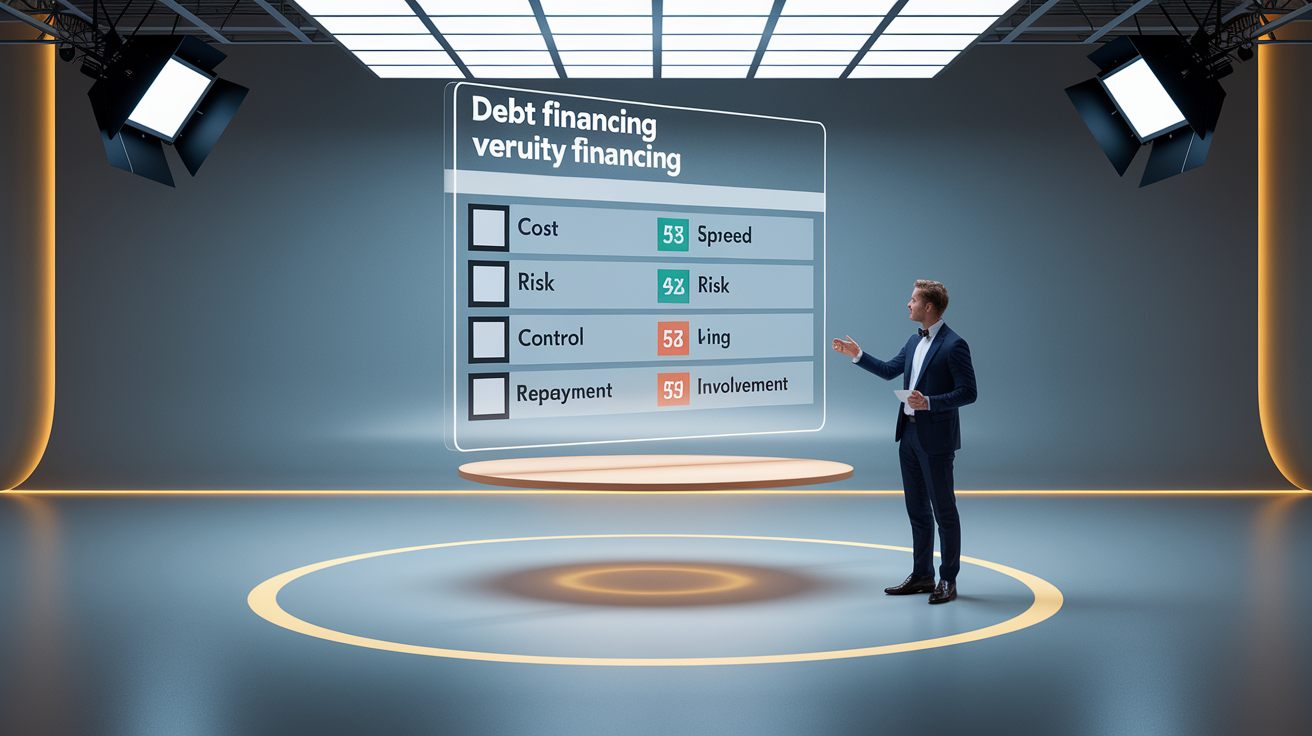
The table below organizes the most important decision variables side by side. Use it to score your business against each criterion, then tally which column fits your current situation and priorities. Most founders find that four or more criteria pointing in the same direction make the choice clear.
| Criteria | Debt Financing | Equity Financing |
|---|---|---|
| Cost of Capital | Interest rate (typically 6 to 15% annually); tax-deductible; total cost is fixed and known upfront | Ownership percentage given up; cost is uncertain and depends on future profits and exit valuation; no tax benefit |
| Speed to Capital | Days to weeks for alternative lenders or lines of credit; weeks to months for traditional banks | Weeks to months for angel rounds; months for venture capital; requires pitch decks, diligence, and negotiation |
| Risk and Repayment | Fixed repayment schedule regardless of revenue; default risk if cash flow fails; collateral may be seized | No repayment obligation; investors share downside risk; capital is patient and tied to business success |
| Control and Decision Authority | Full ownership and control retained; lender has no governance rights (only repayment claim and covenants) | Ownership diluted; investors often gain board seats or veto rights on major decisions; ongoing governance involvement |
| Repayment Obligations | Principal and interest due on fixed schedule (monthly or biweekly); early payoff usually allowed | None; investors profit only through dividends or exit; no scheduled payments |
| Investor or Lender Involvement | Minimal; lender monitors covenants and payment history but does not participate in operations | High; equity investors often provide mentorship, introductions, and strategic input; expect regular updates and influence |
Read across each row and mark which column better matches your current needs and constraints. If you score heavily in the debt column but lack the cash flow or operating history to qualify, the matrix tells you to either delay financing until those conditions improve or pivot to equity despite the control trade-off.
Financial Metrics That Guide the Decision

The debt service coverage ratio is the single most important number for evaluating loan affordability. DSCR is calculated by dividing your net operating income by total annual debt service (principal plus interest). A ratio above 1.0 means you generate enough cash to cover the payments. A ratio above 1.25 signals a comfortable margin that absorbs revenue dips without triggering missed payments.
Most lenders require a minimum DSCR between 1.15 and 1.25, and anything below 1.0 disqualifies you from traditional debt entirely. If your projected DSCR sits between 1.0 and 1.15, you can access debt only through higher-cost alternative lenders or by putting up additional collateral.
EBITDA stability and trend matter almost as much as the absolute level. Lenders and equity investors both review your earnings before interest, taxes, depreciation, and amortization over the trailing 12 to 36 months. Consistent or growing EBITDA signals predictable operations and supports a higher debt load. Volatile EBITDA, swings of more than 20 percent quarter-to-quarter, raises red flags for lenders and pushes you toward equity, where investors price in the volatility and bet on long-term growth rather than near-term payment reliability. For early-stage companies, negative EBITDA is normal, but it also means debt is unavailable unless you can secure the loan against hard assets like equipment or real estate.
Valuation multiples and burn rate become the key metrics when equity is on the table. Pre-revenue or high-growth businesses are valued based on comparable company multiples (revenue or user growth multiples in the sector) rather than profitability. If your industry’s median valuation is 5x annual recurring revenue and you’re raising $500,000, you should expect to give up roughly 10 percent equity at a $5 million post-money valuation. Burn rate, your monthly cash outflow, tells investors how long the capital will last and whether you can reach the next value inflection point before needing another round.
The core metrics to calculate before choosing:
Debt Service Coverage Ratio (DSCR): target greater than 1.25 for safe debt capacity; calculate using trailing 12-month operating cash flow divided by projected annual loan payments.
EBITDA volatility: standard deviation of quarterly EBITDA over the past two years; less than 15 percent supports debt, more than 30 percent favors equity.
Implied cost of equity: percentage of ownership given up multiplied by projected annual ROE; compare to after-tax interest rate on debt to see which is cheaper over a five-year horizon.
Burn rate and runway: monthly cash outflow; ensure equity raise provides at least 18 to 24 months of runway to the next milestone or breakeven.
Matching Financing Type to Stage of Business
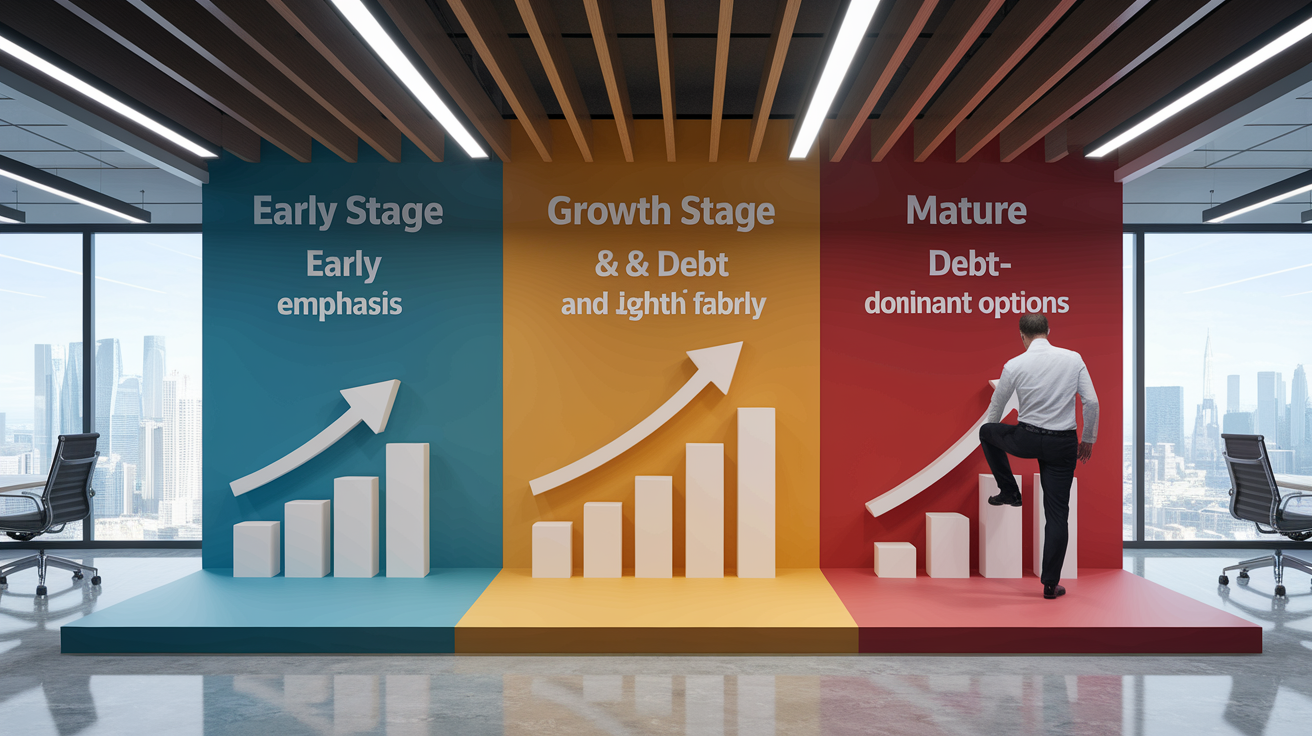
Stage determines both the availability and suitability of each financing type. Early-stage companies with minimal revenue and no operating history can’t meet lender underwriting requirements, so equity is the only path unless the founder can pledge personal assets or secure an SBA-backed loan with a strong personal guarantee.
As the business matures and revenue becomes predictable, debt becomes cheaper and faster than equity. Growth-stage companies with product-market fit and scaling operations often use a mix: debt for predictable capital needs like equipment or working capital, and equity for large expansion moves like entering new markets or acquiring competitors. Mature companies with stable cash flow and established credit profiles can access the lowest-cost debt and use equity only for major strategic pivots or ownership transitions.
| Stage | Recommended Financing Type | Key Reason |
|---|---|---|
| Early Stage (pre-revenue or less than 2 years operating history) | Equity (angel investors, friends and family, seed VC) | No cash flow to service debt; lenders require operating history; equity investors bet on future potential |
| Growth Stage (proven revenue, scaling operations) | Mix of debt and equity; debt for working capital and equipment, equity for expansion and large growth bets | Predictable revenue supports debt repayment; equity funds high-risk, high-reward growth that exceeds debt capacity |
| Mature Stage (established, stable cash flow, profitable) | Debt (term loans, lines of credit, asset-based lending) | Strong credit profile and cash flow unlock low-cost debt; control and ownership preservation are priorities; equity dilution is unnecessary |
Practical Tools: Scorecard and Checklist for Decision-Making

A simple scorecard forces you to quantify the qualitative factors that often cloud the decision. Rate each factor on a 1-to-5 scale, apply a weight to reflect its importance to your business, then multiply to get a weighted score. Add up the weighted scores and compare: a higher total in the debt-favorable direction signals that loan financing fits your current situation, while a higher total in the equity-favorable direction points toward raising investment capital. The scorecard also surfaces which single factor is driving the decision, so you can stress-test that assumption.
Use the checklist below to confirm you have the information and readiness required before approaching lenders or investors. Missing even one item can delay funding by weeks or disqualify you entirely, so treat the checklist as a pre-flight review.
Financing Readiness Checklist:
Trailing financial statements. Gather 12 to 24 months of profit-and-loss statements, balance sheets, and cash flow statements; lenders and investors require these to model risk and returns.
Cash flow projection. Build a month-by-month forecast for the next 12 to 24 months, including the proposed financing and how it will be deployed; show sensitivity scenarios for revenue dips of 10 to 20 percent.
Use of funds breakdown. Document exactly how much capital you need and what it will pay for (equipment, payroll, inventory, marketing spend); vague requests get declined.
Debt service calculation. If considering debt, calculate the monthly payment amount and confirm your DSCR exceeds 1.25 using conservative revenue assumptions.
Ownership cap and dilution tolerance. If considering equity, decide the maximum percentage of ownership you’re willing to give up and the minimum valuation you’ll accept; know your walk-away point before negotiation.
Collateral inventory. List all assets that could secure a loan (equipment, real estate, receivables, inventory) and their current market value; compare to the loan amount to estimate loan-to-value ratio.
The scorecard structure below helps you quantify your position. Fill in your own scores, apply weights based on what matters most to your business, then calculate the weighted total to see which financing path the numbers support.
| Factor | Score 1 to 5 (1 = equity-favorable, 5 = debt-favorable) | Weight (total must = 1.0) | Weighted Score |
|---|---|---|---|
| Cash flow stability and predictability | |||
| Desire to retain full ownership and control | |||
| Availability of collateral or operating history | |||
| Need for investor expertise, network, or mentorship |
Final Words
Decide fast: match your cash flow stability and ownership priorities to debt or equity. Debt works when revenue is steady and you want to keep control; equity fits when you need big growth capital and can accept dilution.
The post gives a compact decision framework, a comparison matrix, key metrics like DSCR and burn rate, and a 60-second checklist so you can test fit quickly.
Use the decision framework for choosing loan vs equity financing to score fit, spot risks, and set clear guardrails. Small, deliberate steps beat guessing — you’ve got a sensible path forward.
FAQ
Q: How to choose between equity financing and debt financing, and what factors determine that choice?
A: Choosing between equity and debt financing depends on cash-flow stability, growth pace, ownership dilution tolerance, collateral availability, and cost; use debt for steady cash and control, equity for fast growth without immediate repayments.
Q: When evaluating different loan options, what should determine your decision?
A: When evaluating loan options, you should base the decision on total cost (interest plus fees), repayment schedule and flexibility, covenants, collateral requirements, and how the payments fit your cash flow.
Q: Which type of decision involves determining the best mix of debt and equity financing?
A: Determining the best mix of debt and equity financing is a capital-structure decision; it balances cost, control, risk, and growth needs to match your cash-flow capacity and ownership goals.